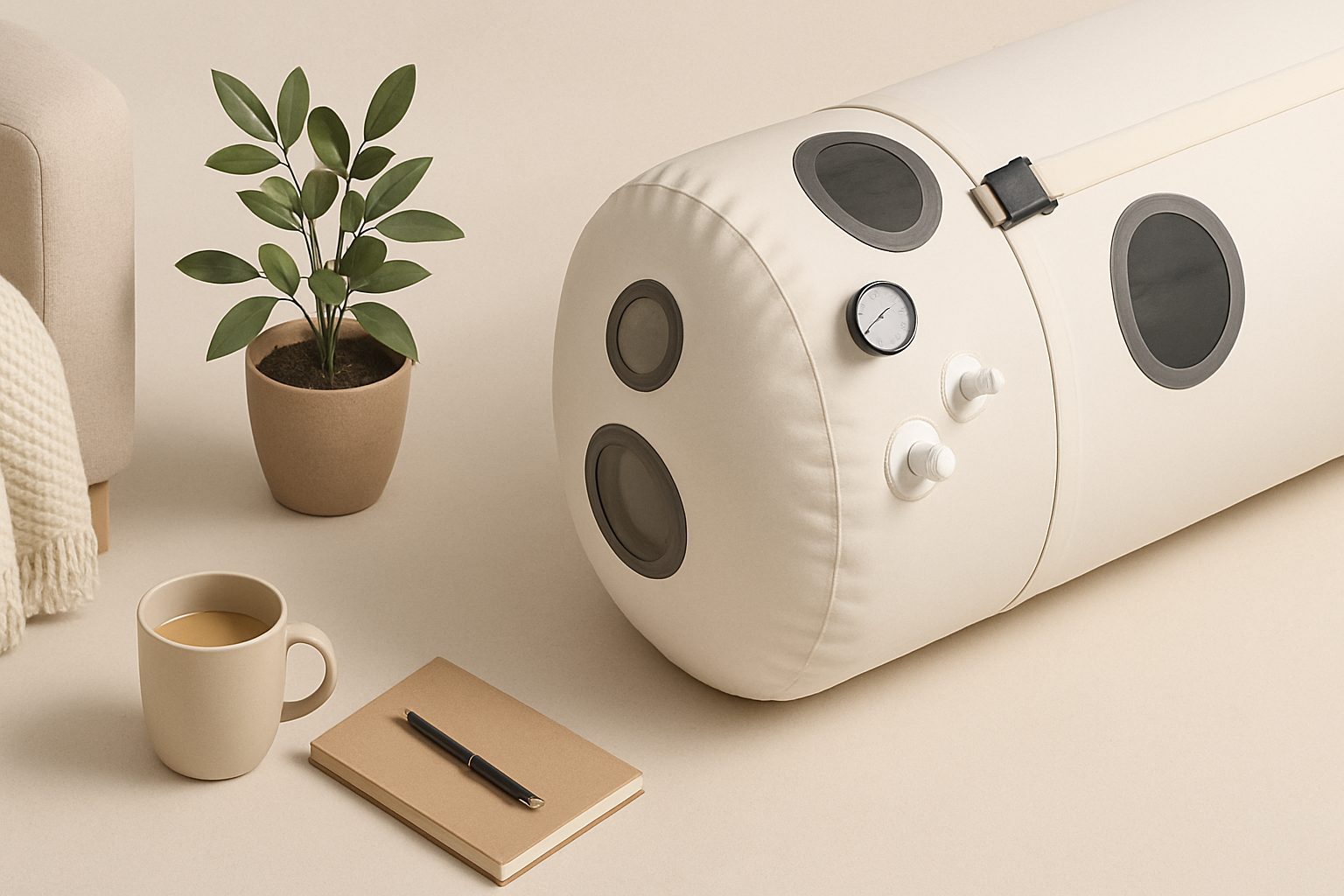
How Does a Home Hyperbaric Chamber Work? A Plain-English Guide for UK Buyers
If you've heard about hyperbaric chambers but the science sounds mysterious, you're not alone. The name alone makes it sound like something from a sci-fi film. But the principle is straightforward: a hyperbaric chamber is a sealed space where the air pressure is gradually increased above normal atmospheric levels, which allows your body to absorb more oxygen than it would breathing air at sea level. Here's how it actually works, and why people use them at home.
Atmospheric Pressure and How It Matters
To understand hyperbaric therapy, start with a simple fact: at sea level, the air around you is pressing down on your body with about 14.7 pounds of force per square inch. This is normal atmospheric pressure, which you're so used to that you don't feel it.
Inside a hyperbaric chamber, this pressure is increased — usually to between 1.3 and 3 times normal atmospheric pressure, depending on the chamber and the treatment. When pressure increases, the air becomes denser. More air molecules are packed into the same space. This density is the key: it's what allows your body to pick up and use extra oxygen.
How Oxygen Gets Into Your Blood and Tissues
Here's where the chemistry matters. Normally, oxygen travels in your blood in two ways. Most of it (about 98%) binds to haemoglobin, a protein in your red blood cells. A tiny amount (roughly 2%) dissolves directly into your blood plasma — the liquid part of your blood.
At normal pressure, that 2% dissolved oxygen is all your body can manage. But increase the pressure, and something changes. Oxygen becomes more soluble in plasma, meaning more of it can simply dissolve into your blood without needing to attach to haemoglobin at all. A hyperbaric chamber at 2.8 atmospheres (a common therapeutic pressure) can increase dissolved oxygen levels in your plasma by up to 15-fold.
This matters because dissolved oxygen can reach areas where blood flow is poor or restricted. It can penetrate deeper into tissues, including bone and scar tissue, where oxygen-starved cells might be struggling. This is why hyperbaric therapy has been used medically for decades — not as some alternative wellness gimmick, but as a legitimate treatment for decompression sickness, diabetic wound healing, and carbon monoxide poisoning.
What Actually Happens During a Session
A typical home hyperbaric session works like this. You enter the chamber, lie down, and the door is sealed. The chamber is gradually pressurised over 10 to 15 minutes. You'll feel pressure in your ears (similar to flying or diving), which you manage by swallowing or gentle ear-clearing techniques.
Once at the target pressure, you simply rest. Most treatments last 60 to 120 minutes. Your body absorbs the extra oxygen. Then, just as gradually, the pressure is reduced back to normal over another 10 to 15 minutes. The whole session takes 90 minutes to 2.5 hours, depending on the protocol.
Modern home chambers use compressed air or oxygen concentrators to increase pressure. Some soft-chamber models (fabric-sided, less expensive) use air only; hard-shell chambers can work with either air or oxygen. The choice affects both the maximum pressure achievable and the oxygen levels available to your tissues.
What Actually Changes in Your Body
The increased pressure and oxygen don't stay in your bloodstream forever. Once you leave the chamber, pressure returns to normal immediately, and dissolved oxygen levels drop back within a few hours. This is why hyperbaric therapy is usually prescribed as a course — 20 to 40 sessions over several weeks — rather than a one-off treatment.
The theory is that repeated exposure triggers physiological adaptations. Improved blood flow. Better tissue healing. Reduced inflammation. The evidence for these effects is strong in clinical settings for specific conditions, weaker for general wellness claims.
The Honest Limitations
Home hyperbaric chambers aren't magic. They work within specific parameters. Pressure levels matter — a soft chamber at 1.3 atmospheres delivers significantly less dissolved oxygen than a hard chamber at 2.8 atmospheres. The gas you're breathing matters too: oxygen-only therapy is more effective than air, but oxygen concentrators (which produce oxygen at lower pressures) are less convenient and more expensive than simple air compressors.
You also can't speed up the process. Decompression must be gradual — too-fast pressure reduction risks nitrogen bubbles forming in your tissues, which defeats the purpose. Safety devices prevent this, but it means each session takes time. If you're expecting instant results, hyperbaric therapy will disappoint.
There's also the question of why you're using it. Medical-grade hyperbaric oxygen therapy for proven conditions (wound healing, decompression sickness) has solid evidence behind it. Using a home chamber for general wellness, athletic recovery, or chronic fatigue is less clearly supported. Some people report benefits; clinical trials are limited. It's worth being honest with yourself about what you're hoping for.
Ready to Learn More?
Now that you understand how the pressure and physics work, the next step is understanding which type of home chamber suits your needs and budget. Our main buying guide compares soft and hard chambers, reviews popular models in the UK market, and walks through the costs and practicalities of owning one. It's the place to start if you're ready to take the leap.
More options
- Portable Hyperbaric Chambers (1.3–1.5 ATA Soft-Shell) (Amazon UK)
- 10-Litre Oxygen Concentrators for Home HBOT (Amazon UK)
- Hyperbaric Chamber Inner Liners & Comfort Accessories (Amazon UK)
- Anti-Static Floor Mats & Hyperbaric Safety Equipment (Amazon UK)
- OxyHealth & Premium Hard-Shell Hyperbaric Systems (UK Distributors via AWIN) (Amazon UK)